Writing a novel “for real” is a lot…
I imagine I'm not alone in my past approach to novel-writing. I've always had a job (or two, or three; ah, the life of a freelancer), and my commitment to completing a story was buffeted at every turn by brain drain, scheduling conflicts, and more pressing private engagements, like doomscrolling. I'm also a serial starter. A new idea occurs to me at least weekly, and yet the finished projects to my name (outside paid work, of course) number well below 50 a year.
When an opportunity arose in late April to focus more seriously on writing a novel, I readily accepted it. No, I wasn't offered an advance for an inspired plot, and I didn't win the lottery. Rather, a part-time job ended abruptly and my partner—bless his good soul and firm knowledge of his subject matter—suggested that instead of finding a new gig, I spend the summer maintaining my current clients and actively attempting to finish the story I had started a few months earlier, which had only a half-baked outline and fewer than 10,000 words in place.
That's how I became an official part-time author. Every weekday morning, I sit down first thing to write. I set a daily goal of 2,000 words, and a monthly goal of 30,000 (yes, that's fewer than 2000 x 20, but I'm nothing if not pragmatic). I started May 1st.
Today, June 17th, I typed the 55,000th word of my novel, putting me well in range of my monthly goal, and it feels like time for a What I've Learned roundup.
The novelty (har har) wears off
Anyone who's pursued writing for any length of time has likely read interviews with famous authors who discourage up-and-comers from thinking it's all fun and games. Sure, quoth they, I "get" to write books for work. But doing anything every day, especially for hours and hours a day as many writers do, gets, if not old, at least uneven in its motivation.
When you write for a job (I wish I could say for a living; someday, perhaps), you still have to sit down at your computer when you absolutely hate the scene you're working on, when you have no idea where your plot is going next, and when you recently decided to completely cut a character and are fully aware of how much work that'll be in draft 2. You have to put in the time when it's gorgeously sunny outside, when you have the sniffles, and when your kid or your cat won't stop trying to climb in your lap. It doesn't matter if you're questioning the plausibility of the storyline or sore from slouching over your keyboard all week. You still have to write.
Maybe this is a slight oversimplification since, like many self-employed people, my schedule is flexible. But in order to reach my targets and realize my goal—to have a "useable" draft ready to send to an editor or publisher by August 31—I need to abide by a structure. I must write. Every day.
And believe me when I say, there are days when I'd rather do anything but.
Outlines are amazing, but they aren't the be-all-end-all
I think a big reason my novel-writing goals failed was my lack of outline. I enjoy being an "intuitive" writer (even as I type that, I'm already apologizing for it). I want my characters to develop naturally, not be hemmed in by a structure I designed before I knew them very well.
Turns out, outlines are amazing. Rather than shackling your protagonist to a particular course, they provide checkpoints. With a checkpoint, you have just enough structure to see the glowing pin on the top of the mountain, but still two dozen routes you might take to get there.
So, having accepted the inevitability of outlining, I made one for this book. It's a mystery, I should mention, and it seems to me of the upmost hutzpah to think you can write a coherent, cohesive mystery plot without an outline. During this process, I started looking into different approaches and learned that most advocates of outlines don't mistake them as unalterable roadmaps. Turns out, many people love creating outlines and equally love blasting them apart or ignoring them completely on the daily.
If I started this journey with the utmost faith in my outline, it's since proved the adage that even our heroes are fallible. To be clear: I don't blame the outline. It simply serves to show me just how organic and circuitious this whole thing really is.
The cognitive drain is real
Two thousand words a day felt like a cop-out when I chose it. I'm a nutrition coach; I know all about the behaviour change benefits of setting small, simple goals—we're more likely to be consistent with them, so they're more likely to succeed, and as a result, we're most likely to get that boost of accomplishment that keeps us going. So, yes, that was my thinking, but I still cringed every time I repeated this itty-bitty baby number to myself or someone else. I felt like a slacker.
But here's the thing: how much I write in a day has nothing to do with my typing speed. If I was transcribing something from a handwritten document onto the screen, I could do 2,000 words in under half an hour. But with the odd exception, novel-writing words don't flow out of me (or most people, far as I know) at 100 words a minute. Even practicing the "just write, don't backtrack" first draft approach, like I am, there are still long pauses while I sort through scene description adjectives, muttering aloud of dialogue to see how it sounds, and moments when it suddenly becomes absolutely imperative, in the middle of a sentence, that I check Amazon for memory foam slippers.
It's tiring to write something straight from your brain. Sure, I have the hundred plus (guesstimate) mystery novels I've read over the years to inspire me, but these characters—their interactions, inner monologues, conflicts, and discoveries—are calling on a degree of thoughtfulness and split-second prefrontal cortex-to-fingertip translation that puts me in mind of Link's rapidly depleting stamina wheel in Breath of the Wild. If I sprint flat out up a literary mountain, I'm gonna need to take some breathers along the way.
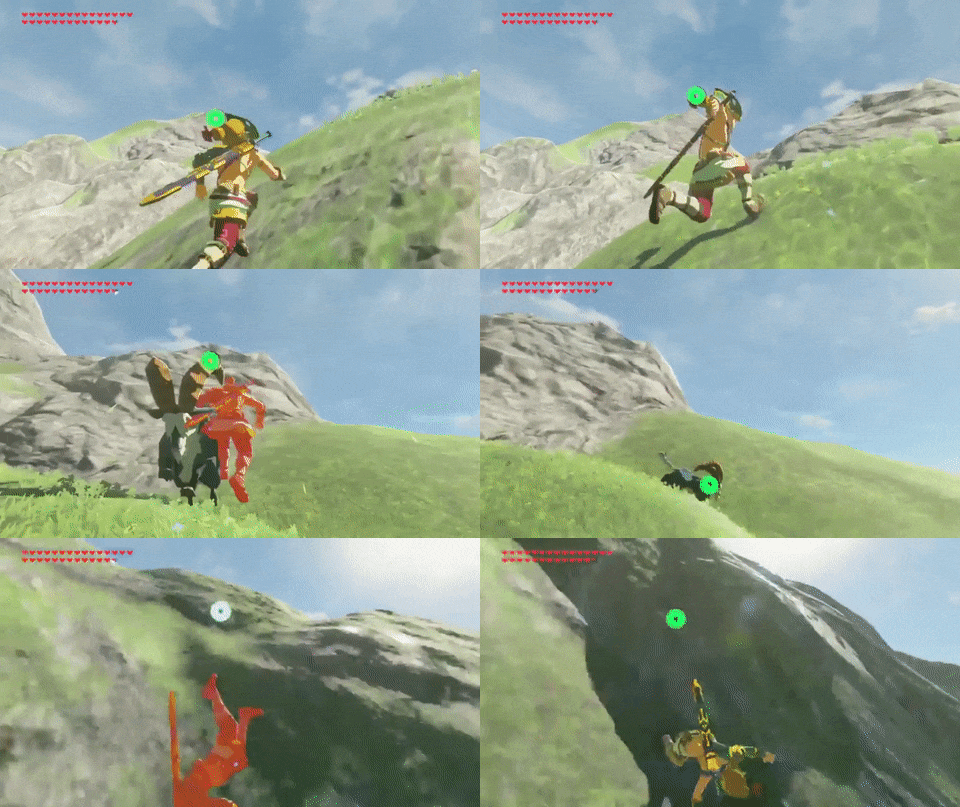
So no, in case you're wondering, I don't hit 2,000 words every day. Other days, I blast right past it (though never by much). That's okay, I tell myself as check the mail for the second time today just to leave the house.
And it is. It is okay that I am not totally jazzed to sit down and start typing every morning. It's okay that my outline is an ever-shifting behemoth with more stream-of-consciousness brain dumping than actual guidance. And it's okay that 90 minutes of writing my novel feels like the mental equivalent to a six-hour customer service shift.
Because I'm a writer part-time author. This is what I do.